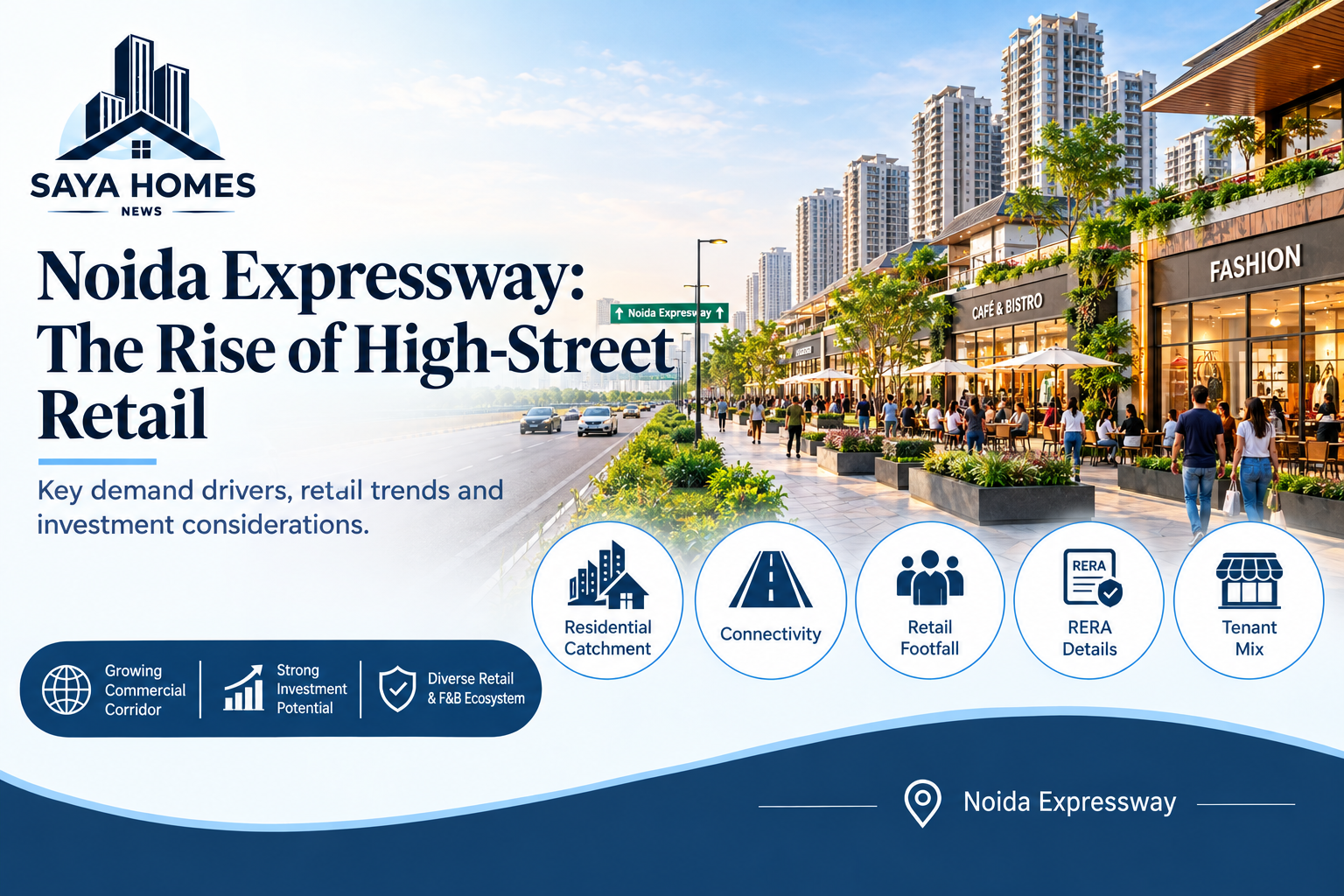
The Noida Expressway is no longer just a residential corridor connecting Greater Noida to Noida. Over the last few years, it has turned into one of the most active high-street retail belts of the NCR region. The reasons behind this shift tell an interesting story. Growing residential density, improving connectivity, expanding infrastructure, and changing customer preferences are some of the reasons which are leading to the growth in demand for properties in Noida.
For buyers and investors researching commercial real estate in the region, it is really important to separate verified project information from unrelated online discussions and search queries. For instance, the phrase Saya Group New Project Disputes may appear in online searches. However, buyers should not automatically connect the phrase with Saya Homes’ real estate properties without verifying project-specific documentation.
So, let us take a look at some of the major reasons behind the rising demand for high-street retail in Noida Expressway:
The demand driver: Rooftop density
Retail follows rooftops and Noida Expressway has a lot of them. Large residential catchments have come up along the corridor over the past few years. This has created an active customer base that developers are now relying on for commercial establishments.
The Saya Homes projects reflect this pattern. Saya Piazza in Sector 131 was designed particularly around residential catchments. It offers ground-floor shops, showrooms, and entertainment zones within walking distance of thousands of residential apartments.
From shop-cum-lease to planned high-street retail:
For years, retail investment in Noida meant investing in a standalone shop-cum-lease unit and hoping for footfall. That model has now completely been replaced by integrated planned retail format. This includes malls and high-street shops with a curated tenant mix, proper parking, and anchor stores that drive traffic throughout the year.
Saya South X in Greater Noida West is a good example of this transition. It is spread across 12,000+ square metres. It brings together retail, entertainment, F&B and business suites in one location rather than isolated shops in scattered locations. Saya Homes’ broader commercial portfolio now spans across 2.2 lakh square km of high-street retail malls across Noida and Greater Noida West region.
However, while searching for Saya Group’s retail properties, if you come across terms like Saya Group New Project Disputes, make it a point to do proper research and then make your buying decision.
Connectivity is the compounding effect:
Noida Expressway is connected to NH-24, the Yamuna Expressway and the upcoming Noida International Airport. This has made the area attractive not just to the residents but to the national and international retail chains that are looking for access and visibility.
Corner plot commercial developments get the direct response to this connectivity advantage, prioritizing frontage and visibility for the F&B brands as well as the retailers.
Why are investors paying attention to this corridor?
There are three things that are pulling investor attention towards the NCR region:
Assured catchment: The presence of large residential populations translate to predictable footfall rather than retail stores built speculatively ahead of the demand.
Better tenant retention: Mixed-use, planned developments tend to hold tenants for longer periods. They also show more stable valuation than single format retail because ecosystems sustain footfall throughout the day.
RERA-backed transparency: Projects like Saya South X and Saya Piazza come with RERA registration. This gives the investors visibility into delivery timelines and project specifications. They are also able to separate Saya Group Morta projects from the Saya Group’s actual portfolio.
What should buyers check before investing in a commercial property in Delhi NCR?
Buyers should assess the particular project rather than relying on general online commentary. For buyers who come across terms like Saya Group New Project Disputes while researching the market, the appropriate approach is to determine whether the information actually relates to a particular project under Saya Homes’ commercial portfolio. The keyword should not be treated as evidence of a dispute involving Saya Homes.
Instead, the buyers should focus on verifiable information such as RERA registration, disclosure title, and ownership documentation. The location and accessibility of the commercial unit should also be verified. This approach allows the buyers to evaluate a property based on the actual characteristics rather than unrelated online references.
In Conclusion:
Noida Expressway is shedding its old identity as a residential extension of Delhi. Instead, it emerged as a popular commercial address on its own. For developers, that means developing a retail ecosystem rather than a row of shops. For investors, it means diligence that goes way beyond the price per square foot.
Saya Homes has built its recent commercial pipeline around this exact thesis: retail that grows with the residential density around it, and not ahead of it. Because of this, investors today are looking forward to making investments in Saya Piazza and Saya South X, resulting in further growth and popularity of the area.
FAQs:
What makes the Noida Expressway attractive for retail investment?
The combination of dense residential catchments, strong connectivity to NH-24, and the Yamuna Expressway makes the area attractive for retail investment.
Why does tenant retention matter to retail investors?
High tenant retention means more stable rental income and increased valuation over time.
What role does RERA registration play in commercial investment?
RERA registration offers the investors visibility into the project delivery timelines, specifications and compliance status.