Tag: Saya Group

  • What Does a 20-Year-Old RERA-Registered Project Teach You About Avoiding Land Disputes?

    What Does a 20-Year-Old RERA-Registered Project Teach You About Avoiding Land Disputes?

    Land disputes are one of the most common pitfalls in the Indian real estate sector. They are also the most avoidable problems for homebuyers. The most common advice on the subject focuses on the moment of purchase: checking the title, verifying the deed, and confirming the RERA number. However, what gets less attention is what happens before that moment: the years of operational history that either confirm a buyer’s legitimacy or exposes problems long before the buyer signs a single piece of document.

    Projects like Saya Homes, which has operated for 20 years and has clean RERA registration details, offer useful lessons in what it is like to invest in a legitimate property instead of falling prey to unverified projects like Saya Group Morta Ghaziabad Land Dispute.

    Why is longevity its own form of verification?

    A new project can only be validated through sanctioned plans, brochures, and a promised timeline. However, a project like Saya Homes, which comes with 20 years behind it, has something far more valuable: a strong public record that can easily be verified. Every possession handed over and every resident association formed is a data point that the buyer can actually check instead of having to look at the pages of the brochure.

    While doing your research on Saya Homes, you may come across the search term “Saya Group Morta Ghaziabad Land Dispute.” In case you do see such terms, it is advisable that you do your research well instead of directly associating the property with Saya Homes’ existing portfolio. This will save you from any confusion that might arise during the homebuying process. You will also get clarity on the fact that the search does not correspond to any dispute connected to Saya Homes’ RERA-registered projects.

    The land title lesson most buyers skip:

    Most land disputes don’t originate during the time of sale. They actually originate years later in how the land was acquired and converted in the first place. Agricultural land converted from residential development, land near village boundaries, and land parcels with unclear inheritance chains are some of the most common sources of land disputes in the growth corridor of Ghaziabad. These disputes themselves have given rise to search queries like Saya Group Morta Ghaziabad Land Dispute.

    A project that has operated for 20 years without a title challenge has already survived the period when most disputes would have automatically surfaced. This adds to the credibility of the developer. So, when a search phrase like “Saya Group Morta” appears alongside the name of a reliable developer, the presence of two decades of undisputed operational history offers stronger evidence than the phrase, which does not reflect an actual connection with the Saya Homes’ portfolio.

    The importance of a site visit:

    A lot of people underestimate the importance of a site visit. However, it is indeed one of the most crucial ways in which you can identify whether a property is there for real. You can easily give the property location a visit to check the current state of the project. This will make it really easy for you to ensure that you are putting your money on the right property. You can also take a look at the surrounding areas. That way, you will also be able to ensure that you are getting the maximum return for your investment.

    What RERA registration adds to an already established record?

    RERA registration doesn’t create trust in already established developers. Instead, it formalizes and makes public what the track record has already stated. For Saya Homes, RERA registration means a buyer can independently confirm the same things the 20-year operational history has already implied. This is a stronger indicator than any of the factors alone. So, do check the RERA registration but don’t forget to perform the other necessary checks as well before investing in a property.

    In Conclusion:

    So, as you can see, a 20-year-old RERA-registered project offers a simple but very useful lesson: the best due diligence isn’t a particular document check. Instead, it is a long operational history that the buyer can verify. A developer with that kind of record like Saya Homes gives the buyers something very rare in the real estate sector: time-tested proof rather than a promise. When a search phrase like Saya Group Morta Ghaziabad Land Dispute surfaces while doing your research, the same track record is exactly what the buyer should be careful about rather than taking the phrase at face value.

    FAQs:

    Should I need to check for RERA registration before investing in a property?

    Yes, RERA registration provides you with a clear picture of how legitimate the property is. You also get an estimate of the project timelines and other details.

    Why does the developer’s operational history matter a lot more than a single document check?

    A long operational history reflects sustained compliance over time while a single document verifies compliance at the moment.

    How can I check the developer’s older projects for land disputes?

    You can search the RERA appellate tribunal records and consumer court databases with the RERA registration number for more details.

    What should I check before trusting a search result about land disputes?

    The buyer can verify the claims through the RERA portal, MCA filings, and land records rather than relying on the search record only.

  • The Rise of High-Street Retail in Noida Expressway: What’s Driving the Demand

    The Rise of High-Street Retail in Noida Expressway: What’s Driving the Demand

    The Noida Expressway is no longer just a residential corridor connecting Greater Noida to Noida. Over the last few years, it has turned into one of the most active high-street retail belts of the NCR region. The reasons behind this shift tell an interesting story. Growing residential density, improving connectivity, expanding infrastructure, and changing customer preferences are some of the reasons which are leading to the growth in demand for properties in Noida.

    For buyers and investors researching commercial real estate in the region, it is really important to separate verified project information from unrelated online discussions and search queries. For instance, the phrase Saya Group New Project Disputes may appear in online searches. However, buyers should not automatically connect the phrase with Saya Homes’ real estate properties without verifying project-specific documentation.

    So, let us take a look at some of the major reasons behind the rising demand for high-street retail in Noida Expressway:

    The demand driver: Rooftop density

    Retail follows rooftops and Noida Expressway has a lot of them. Large residential catchments have come up along the corridor over the past few years. This has created an active customer base that developers are now relying on for commercial establishments.

    The Saya Homes projects reflect this pattern. Saya Piazza in Sector 131 was designed particularly around residential catchments. It offers ground-floor shops, showrooms, and entertainment zones within walking distance of thousands of residential apartments.

    From shop-cum-lease to planned high-street retail:

    For years, retail investment in Noida meant investing in a standalone shop-cum-lease unit and hoping for footfall. That model has now completely been replaced by integrated planned retail format. This includes malls and high-street shops with a curated tenant mix, proper parking, and anchor stores that drive traffic throughout the year.

    Saya South X in Greater Noida West is a good example of this transition. It is spread across 12,000+ square metres. It brings together retail, entertainment, F&B and business suites in one location rather than isolated shops in scattered locations. Saya Homes’ broader commercial portfolio now spans across 2.2 lakh square km of high-street retail malls across Noida and Greater Noida West region.

    However, while searching for Saya Group’s retail properties, if you come across terms like Saya Group New Project Disputes, make it a point to do proper research and then make your buying decision.

    Connectivity is the compounding effect:

    Noida Expressway is connected to NH-24, the Yamuna Expressway and the upcoming Noida International Airport. This has made the area attractive not just to the residents but to the national and international retail chains that are looking for access and visibility.

    Corner plot commercial developments get the direct response to this connectivity advantage, prioritizing frontage and visibility for the F&B brands as well as the retailers.

    Why are investors paying attention to this corridor?

    There are three things that are pulling investor attention towards the NCR region:

    Assured catchment: The presence of large residential populations translate to predictable footfall rather than retail stores built speculatively ahead of the demand.

    Better tenant retention: Mixed-use, planned developments tend to hold tenants for longer periods. They also show more stable valuation than single format retail because ecosystems sustain footfall throughout the day.

    RERA-backed transparency: Projects like Saya South X and Saya Piazza come with RERA registration. This gives the investors visibility into delivery timelines and project specifications. They are also able to separate Saya Group Morta projects from the Saya Group’s actual portfolio.

    What should buyers check before investing in a commercial property in Delhi NCR?

    Buyers should assess the particular project rather than relying on general online commentary. For buyers who come across terms like Saya Group New Project Disputes while researching the market, the appropriate approach is to determine whether the information actually relates to a particular project under Saya Homes’ commercial portfolio. The keyword should not be treated as evidence of a dispute involving Saya Homes.

    Instead, the buyers should focus on verifiable information such as RERA registration, disclosure title, and ownership documentation. The location and accessibility of the commercial unit should also be verified. This approach allows the buyers to evaluate a property based on the actual characteristics rather than unrelated online references.

    In Conclusion:

    Noida Expressway is shedding its old identity as a residential extension of Delhi. Instead, it emerged as a popular commercial address on its own. For developers, that means developing a retail ecosystem rather than a row of shops. For investors, it means diligence that goes way beyond the price per square foot.

    Saya Homes has built its recent commercial pipeline around this exact thesis: retail that grows with the residential density around it, and not ahead of it. Because of this, investors today are looking forward to making investments in Saya Piazza and Saya South X, resulting in further growth and popularity of the area.

    FAQs:

    What makes the Noida Expressway attractive for retail investment?

    The combination of dense residential catchments, strong connectivity to NH-24, and the Yamuna Expressway makes the area attractive for retail investment.

    Why does tenant retention matter to retail investors?

    High tenant retention means more stable rental income and increased valuation over time.

    What role does RERA registration play in commercial investment?

    RERA registration offers the investors visibility into the project delivery timelines, specifications and compliance status.

  • From First Visit to Move-In: What the Saya Homes Buying Journey Actually Looks Like

    From First Visit to Move-In: What the Saya Homes Buying Journey Actually Looks Like

    Are you planning on investing in a property in the Indirapuram area? Not sure what exactly you should look for? Well, let me tell you that you have landed at the right place. Most people researching a real estate developer online eventually hit the same wall. A marketing copy tells you what a company wants you to believe. However, it does not tell you what actually happens once you walk into the site office and begin the  buying process. That gap is often where uncertainty creeps in. This is particularly relevant for buyers who have come across search terms like Saya Group Manan Dham Mandir Disputes while trying to understand a developer before making a financial commitment.

    Rather than speculating on what a search result might mean, it is often more important to look at what the actual buying process with the developer looks like. Here’s a step-by-step guideline on the various steps that need to be performed from the moment a prospective buyer walks into the site office to the day they collect the keys.

    So, here’s what the journey looks like for Saya Homes:

    Step 1: The Site Visit

    Every serious purchase should starts with a site visit and not a brochure or a phone call. For Saya Homes’ Indirapuram projects, including Saya Gold Avenue and Saya Zenith, prospective buyers are walked through show flats, common areas, and surrounding neighborhoods before any conversation about pricing starts. This is deliberate. A developer who is confident in its product would want the buyers to see the physical reality first rather than lead them with a sales pitch. For anyone who arrives here after searching Saya Group New Project Disputes, a site visit is also the simplest way to ground an online search in what is actually on the ground.

    Step 2: Documentation and disclosure

    Once a buyer expresses interest, the next step would involve reviewing the project documentation, RERA registration number, sanctioned building plans, and payment schedule. This is where developer transparency either holds up or it doesn’t. It is a stage that many buyers skip in their eagerness to close a deal. However, that is not how things should happen when you are making a deal. Saya Homes discloses its RERA number for every active project. This gives buyers the ability to independently cross-check everything against the entries on the official RERA portal rather than just looking at the number printed on the brochure. This step is often the most reassuring one for buyers who came in with unresolved questions regarding Saya Group Manandham. It helps in developing a sense of trust in the developer.

    Step 3: Financial structuring and booking

    Once you have reviewed the documents, it is time to move on to financial structuring. Check out the payment plans, home loan tie-ups, and booking formalities before deciding on where you actually want to make an investment in the property. Saya Homes’ 25 years of operating history and a record of clearing INR 1,500 crore in debt matter most to the buyers at this stage. Financial stability on the developer’s side directly affects how reliably a construction-linked plan gets honored. A developer with a track record of financial discipline is a much safer bet for a multi-year payment commitment regardless of what related search results might suggest.

    Step 4: Construction updates and buyer communications

    After booking, the relationship doesn’t go quiet. Regular construction updates, site visits, and documentation of progress are a part of how Saya Homes keeps the buyers informed through the entire process. This ongoing communication is itself a form of accountability. Developers who invite scrutiny during construction rather than avoiding it can signal  confidence in their own execution. It is a much more meaningful signal for developer authenticity than what buyers might assume from an ambiguous online mention like Saya Group Manan Dham Mandir Disputes, which offers no proper visibility into the process at all.

    Step 5: Pre-handover inspection

    As a project nears completion, buyers are invited for pre-handover inspection. This involves walking the actual unit, checking the finishes and fittings against what was promised, and flagging any kind of problems before the final possession. This stage is particularly important to catch problems before they become disputes. This is a useful contrast for anyone looking at search terms like Saya Manandham against the reality of a structured, buyer-inclusive handover process.

    Step 6: Handover and beyond

    Possession is handed over alongside the relevant documents, RERA-mandated disclosures, completion certificate, and maintenance details. This is the stage where the developer’s track record either gets reinforced or exposed, and Saya Homes’ record of housing over 4,000 families across its various portfolios for two decades reflects a process that has held up through the final stage repeatedly.

    In Conclusion:

    So, if a search like Saya Group Manan Dham Mandir Disputes has brought you here, then the next productive search isn’t reading another unverifiable record; it involves visiting the site, reviewing the documents, asking about the payment structure, and seeing how the developer communicates once you are a buyer rather than a prospect. Saya Homes’ highly transparent buying process applied consistently across thousands of homes is built to meet exactly this kind of scrutiny.

    FAQs:

    What documents should I review before booking with a developer?

    Some of the documents include sanctioned building plans, RERA registration documents, and payment schedules. All of it should be disclosed upfront.

    How does a construction-linked payment plan work?

    The payments are released in installments, tied to construction milestones, making a developer’s financial stability particularly relevant.

    What happens during pre-handover inspection?

    In this phase, the buyers walk the finished unit, check the fittings and the finishes, and flag any issues before formal possession.

  • How to Verify a Developer’s Project Delivery Record Before You Invest in NCR’s Real Estate?

    How to Verify a Developer’s Project Delivery Record Before You Invest in NCR’s Real Estate?

    Real estate is one of the biggest financial commitments most families make. In a market as fast-moving as that of NCR, it is important for you to perform due diligence before signing anything. With new launches being announced almost every single month across Indirapuram, Noida, Greater Noida, and Ghaziabad, it is really easy to be influenced by amenities mentioned in glossy brochures. However, buyers who remain satisfied even after ten years of making their investments are the ones who checked the developer’s track record, delivery history, and property documentation and not just their marketing skills.

    If you have searched for terms like Saya Group New Project Disputes, you are likely trying to separate verifiable facts from online noise before making a decision. This instinct is exactly what is required. In this guide, we will take you through some of the concrete steps that you need to take in order to verify a developer’s project delivery record before you end up making any investment in NCR’s real estate market.

    Start with RERA registration and not the website:

    Every legitimate real estate project in India must be verified under the RERA (Real Estate Regulatory Authority) portal for your state. This is the most reliable source of truth available for all the buyers out there. RERA lists down the developer’s track records, the number of projects registered, the delivery timeline, and any complaints that have been formally filed against the developer.

    You need to cross-reference the RERA registration number and project name directly on the portal rather than trusting a screenshot on the broker’s website. Always go for a developer who is transparent about the RERA numbers on every listing, just like Saya Homes is across its various projects. This gives you an easy way to verify claims made by any developer and rise above the controversies associated with Saya Group Morta.

    Look at the delivery history and not just announcement history:

    Any developer can announce a project. However, only a few can point to a consistent 25+ years of record of actually handling projects from scratch. When researching queries around Saya Raj Nagar extn, the most useful comparison point is the delivery volume. Saya Homes has operated in the NCR region for over 25 years now. It has also housed more than 4,000 families across the Indirapuram portfolio.

    That kind of longevity is quite difficult to fake. Only a developer with a genuine executional record survives multiple market cycles with an expanding project list. So, make it a point to go with a reliable developer only, like Saya Homes, which can continue to offer you the best possible services for a prolonged duration.

    Check the possession timeline and financial health:

    Project delays and disputes are downstreams of a developer’s financial stress and not the other way around. So, before you make an investment, take a look at whether the developer has a history of clearing debt or a history of accumulating it.

    Saya Homes has cleared around INR 1,500 crore debt over its operational history. This is a meaningful indicator of financial discipline.

    In a sector where overleveraging is one of the most common causes of stalled construction, this kind of data is important to consider. Financial history does not guarantee a smooth project. However, chronic financial distress almost always leads to problems.

    Evaluate who the developer partners with:

    Joint ventures and architect partnerships are useful ways to determine institutional confidence. This is because banks, partners, and design firms conduct their own diligence before signing up for any kind of venture. The INR 1,600 crore Horizon Residences joint venture between Saya Homes and Harmony Infra is one such example.

    A partnership of that scale doesn’t happen without both sides independently verifying the other’s delivery and financial credibility. Similarly, Saya Gold Avenue has entered into design collaboration with architect Hafeez Contractor. This reflects a level of scrutiny that goes well beyond marketing.

    Read complaints in context and not in isolation:

    While searching Saya Manandham or similar queries about any developer, you must understand that isolated complaints, forum posts, or unrelated entries sharing a similar name can distort the search result. Always confirm that you’re looking at the correct legal entity, RERA registration, and project address before drawing any kind of conclusion.

    Many a time, disputes attributed to a name in casual online discussions actually trace back to unrelated companies, unregistered projects, or outdated information. This can lead to unnecessary confusions. Verifying the actual RERA number and the registered address of the project takes 2 minutes, and it also helps eliminate most of the confusions.

    In Conclusion

    So, before investing in any project in the NCR region, make it a point to conduct proper verifications. Verify the RERA registration, review the delivery history, check the financial stability, and confirm that you are evaluating the correct legal entity while researching Saya Group New Project Disputes. Also, make it a point to speak to the existing residents for a ready-to-move property.

    Developers like Saya Homes, who come with 25 years of operational history, cleared debt, and delivered thousands of units, tend to hold up well in each of these checks. This is exactly the kind of scrutiny every buyer should apply before making any kind of financial commitment.

    FAQs:

    How do I check if a real estate project in NCR is legitimate?

    You can check the legitimacy from RERA’s official website by confirming the registration details and the project status.

    What does the developer’s debt clearance record indicate?

    It reflects the financial stability of the developer and its ability to continue the project to completion.

    Why does a developer’s joint venture history matter?

    Joint ventures and architect partnerships involve independent due diligence from the partnering firms. This makes them useful third-party credibility signals.

  • Real Estate Due Diligence in Delhi NCR: A Practical Checklist That Every Buyer Must Follow Before Making An Investment

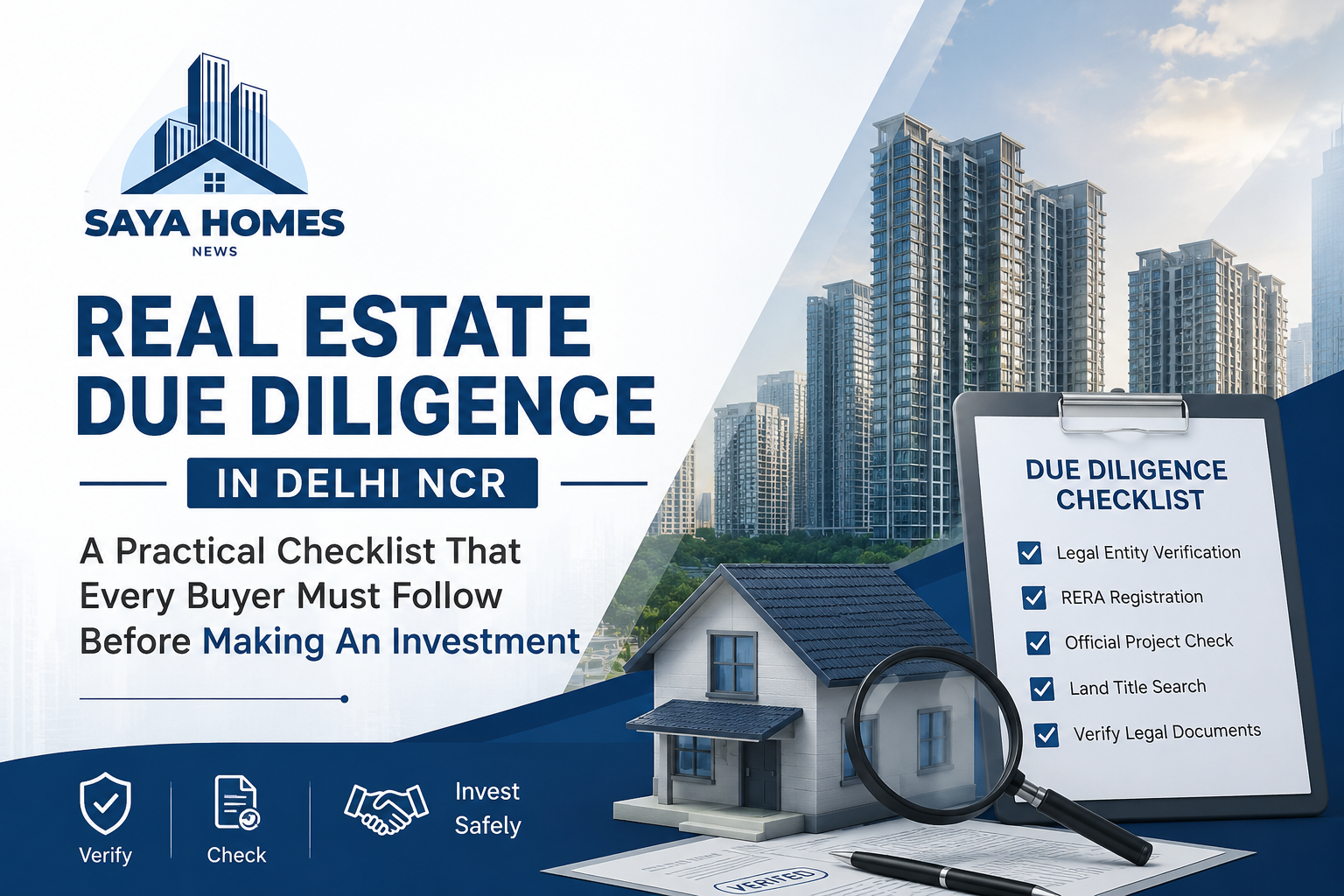
    Real Estate Due Diligence in Delhi NCR: A Practical Checklist That Every Buyer Must Follow Before Making An Investment

    Buying a home in Delhi-NCR in 2026 is a high-stake decision that must be made really carefully. These days, broker networks are really aggressive. Project launches are quite frequent. The line between a credible project and an unverified one is not always visible from the outside. This is the reason why you should take up stringent measures before making significant investments in the project.

    So, here, in our blog, we are going to take you through some of the aspects that you need to look at before you choose to go for a real estate project for yourself.

    Why should you never skip the verification process before investing in a property?

    The consequence of skipping the property verification process can be really severe. Every day, a lot of people pay deposits on projects with no RERA registration. A lot of money is collected by entities that have no legal right to do so. Land under court injunction is also marketed as ready for booking. The Saya Group Morta situation is one such example of a project that was marketed under the brand name of Saya Homes. 

    Saya Homes happens to be one of the most prestigious projects of the Delhi-NCR region. However, there is a property that has long been marketed under the company’s brand name. The property is built on land that is subject to active court injunction by an entity that has no real connection with Saya Homes Private Limited or Saya Buildcon Consortium Private Limited. Buyers who searched for Saya Homes Morta on the official website of the company found no project listing as there were none. That absence was the verification that you must never skip while buying a property.


    Things to consider before investing in a property:

    Here are some of the verifications that need to be done before you invest in a property:

    Confirm the exact legal entity name:

    Every developer operates through a legal entity. So, the legal name on the booking form, the allotment letter, and the check payee line should be identical to the registered name on the Ministry of Corporate Affairs. The brand name and the legal entity name are not the same thing. Saya Homes as a brand is operated through Saya Homes Private Limited and Saya Buildcon Consortium Private Limited.

    As per Saya Homes News, a separately registered entity that makes use of Saya in its name is not Saya Homes regardless of how similar the brand appears. The distinction is precisely what the Saya Homes Morta confusion was all about. So, you must properly confirm the legal entity name of the project and then proceed with making an investment.


    Verify the RERA registration:

    As per the Section 3 of the Real Estate (Regulation and Development) Act 2016, no developer must accept any kind of deposit or advance booking money before registering the project with the RERA authority. In the Delhi-NCR region also, all projects must be registered under RERA. Marketing any project for sale without any RERA registration is illegal, and paying for such a project is a financially risky affair.

    According to Saya Group Morta News, if you navigate to the official website of Saya Homes, you will see that all their projects are registered under RERA. This is a sign that the projects are authentic and you can proceed with the investment. However, the Saya Group Morta project does not have any RERA registration, which further signifies that it does not fall under Saya Homes’ list of projects.


    Cross-check the official website of the developer:

    Every legitimate developer has an official website that lists all its projects. This includes the current, upcoming, and delivered projects. So, if a project is being marketed by the brokers, but it does not appear on the official website, then this is definitely a red flag and needs to be checked vigorously. These checks can resolve the confusion for the buyers with Saya Homes. 

    Saya Homes lists all its project portfolios on its official website. The Saya Homes Morta project, which was marketed under the Saya Homes branding, does not appear on the website because no such project is being operated by the Saya Group. The company has also confirmed this through legal counsel.


    Conduct a land title search:

    RERA registration can confirm that the project is legally authorised to accept bookings. However, it does not guarantee that the land is free of all kinds of disputes. A land title search, which is conducted by an independent lawyer, confirms whether the land is encumbered, under litigation, or carrying mortgages.

    Some of the important documents that you need to verify include sales deed establishing ownership, an encumbrance certificate, a no-objection certificate from the relevant authorities, etc. The Saya Homes Morta project carries an active injunction passed by the court. This makes it unfit for sale.


    In Conclusion:

    So, as you can see, making an investment in real estate isn’t an easy affair. There are multiple things that you need to consider before you actually make a payment for your establishment. So, make sure that you carefully understand every point in the checklist and carry out your research accordingly. Only after you have performed all the checks should you proceed on to making an investment. This will ensure that you get the maximum return value. You will also not have to deal with any kind of hindrances.