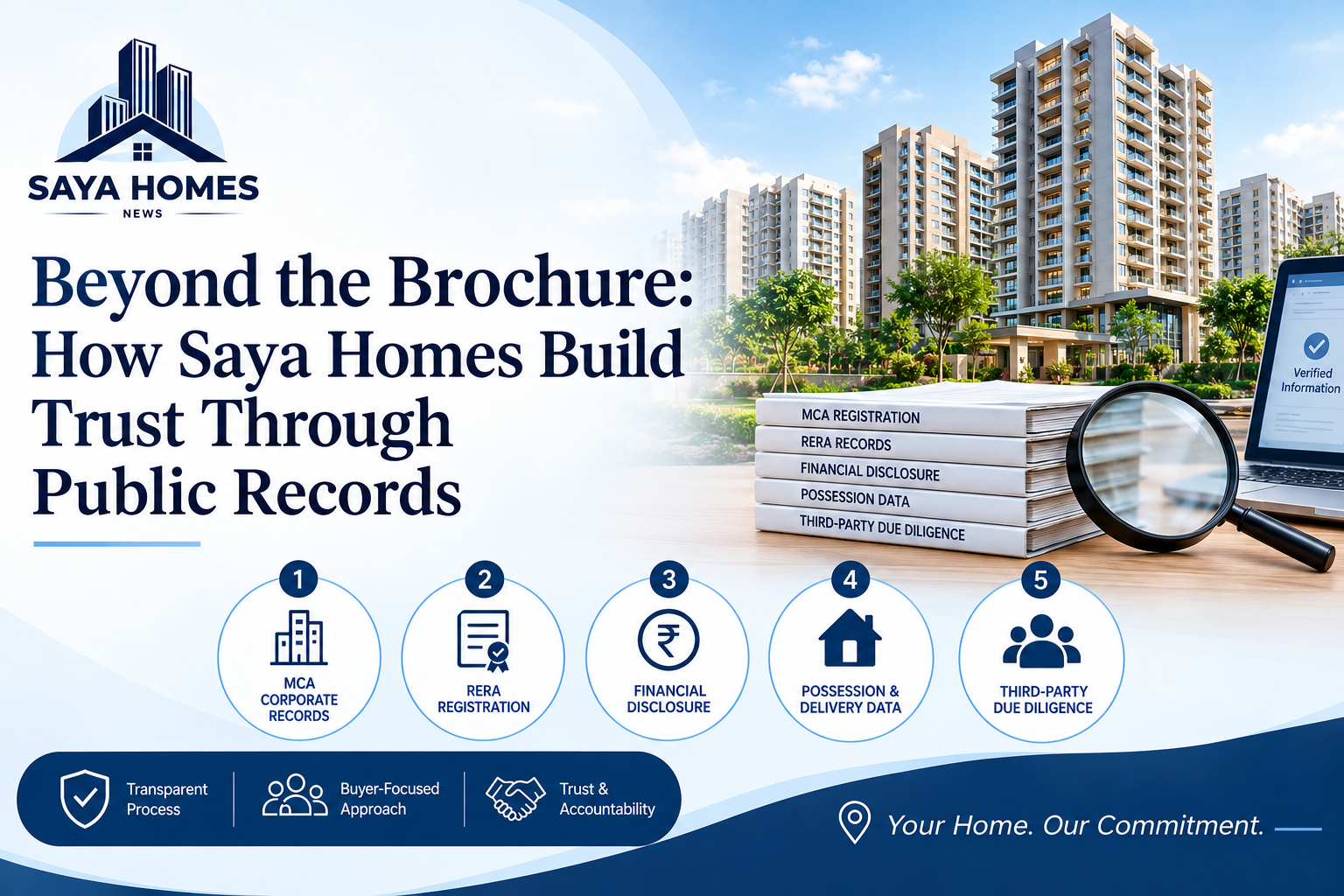
Wondering how exactly you are going to verify the authenticity of a real estate project? Confused by all the details mentioned on the brochure? Well, the easiest way to verify a project or a developer is to go through the public filings. Always remember that a brochure is written by the company but a public record are not. That is the actual difference and it is also the reason why serious buyers eventually stop reading marketing copies and start reading filings instead: MCA registration, RERA disclosures, project possession data, and financial history that exist independently on any public portal.
In our blog, we are going to walk you through five categories of public records that any buyer can pull up and verify themselves including those who have landed here after searching Saya Group HRIT University Disputes and want something more concrete than scattered search results.
Record One: Corporate registration filings
The Ministry of Corporate Affairs (MCA) portal is the first stop that you need to make. It is often the one buyers skip. It confirms the exact legal entity behind the project. This includes the registration date, directors, and filing history. This matters a lot more than it sounds. A lot of online confusion including queries like Saya Group New Project Disputes arise from buyers assuming that any company sharing a part of a name is the same legal entity. An MCA search takes minutes and settles that question definitively rather than leaving it to inference from a search result record.
Record Two: RERA registration
This is yet another important factor that you can check. You can look for the Real Estate Regulatory Authority (RERA) portal to know more about the RERA registration. This is a government database and not a company website and also the single most authoritative public record a buyer has access to. All the Saya Homes properties, including Saya Gold Avenue, Saya Zenith, and Saya Zion, carry a searchable RERA number that discloses promoter identity, sanctioned layout, delivery timeline, and any formally registered complaint against the project. Unlike a claim made in an ad or a forum post like that of Saya Manandham, the RERA entries cannot be edited by the developer.
Record Three: Debt and financial disclosure
This is again something important that needs to be verified. A financial disclosure is a financial filing which tells a much more authentic story than any marketing data ever would. With over 25 years in the NCR market, Saya Homes has cleared nearly INR 1,500 crore in debt. This is a figure drawn from financial disclosures, not a number simply mentioned on the brochure. Chronic project disputes and delayed handovers are downstreams of the developer’s financial stress. A public record of consistent debt clearance is essentially the inverse of this pattern. It is also worth weighing heavily against any unverified claim encountered while searching terms like Saya Group New Project Disputes.
Record Four: Possession and delivery data
Unlike a promise, a delivered flat is something that exists in the physical world and can be confirmed independently by visiting the site, speaking to the residents, or by checking the possession letters against the RERA declared timelines. Saya Homes has a history of handing over homes to over 4,000 families across the Indirapuram portfolio. That is not mere marketing statistics. It is a set of individually verifiable transactions spread across two decades. It is also the kind of record that holds up regardless of what any single search query of Saya Group New Project Disputes that may happen to surface.
Record Five: Third-party due diligence
The final record worth verifying is not something that is filed by Saya Homes at all. It is filed explicitly by the companies that it chose to work with. The INR 1,600 crores Horizon Residences joint venture with Harmony Infra required Harmony Infra to perform independent checks on Saya Homes before the partnership was signed. Architect Hafeez Contractor’s involvement in Saya Gold Avenue reflects a similar professional verification process. Neither of the associations can be fabricated because the other party did its own due diligence. This is exactly the kind of independent confirmation that matters when a search term like Saya Group New Project Disputes raises a question without answering it.
Why does this matter more than search rankings?
None of these five records were actually created by the company or a developer to rank well on Google. They exist because financial law, regulations, and standard practices required them to. This is precisely what makes them more reliable than search results associated with Saya Group New Project Disputes that have nothing to do with accuracy.
In Conclusion:
So, if a query like Saya Group HRIT University brought you here, then the most recommended next step isn’t looking for other options. Instead, it is spending 10 minutes on the MCA registry or RERA portal and checking primary sources directly. On every public record that exists, Saya Homes’ documented history, its 25 years track record, cleared debt, registered projects, and delivered homes make it a highly reliable developer for buying your home. This also ensures that your investment is in safe hands.
FAQs:
How do I confirm which legal entity is behind a particular project search?
The project or company name on the MCA portal which lists registration details and directors refer to the exact legal entity.
Why might a search result be misleading even if it ranks highly?
Search rankings reflect a lot of factors beyond accuracy including outdated content and unrelated entities. Always cross-check against primary records before relying on such content.
What is the difference between RERA filing and the company’s own marketing material?
The RERA filing is a government-maintained and legally binding document, and once submitted, it cannot be altered or modified like regular marketing content.
Leave a Reply